Is Status-Quo Bias Killing Your Sales?
Oct 12, 2026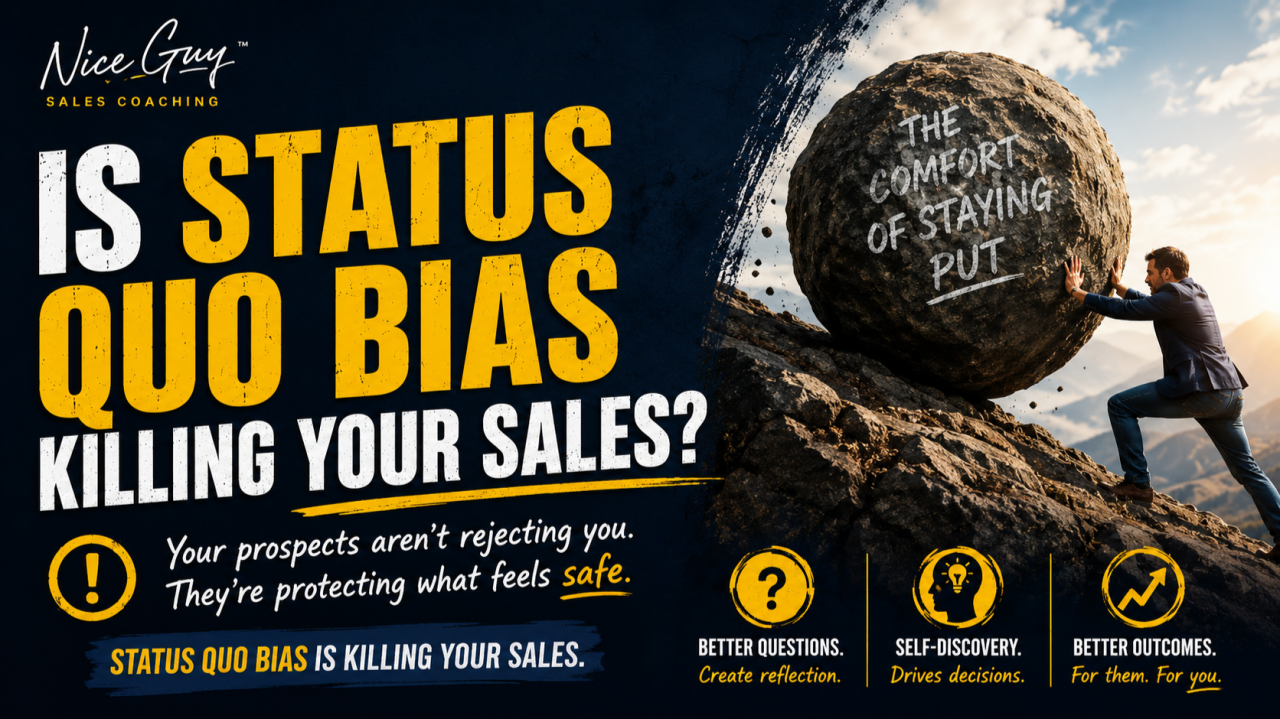
Is your buyer not seeing your point of view?
That is not a 'you' problem. That is not a pitch problem. (We shouldn't be pitching anyway. Ask me why not.) And it is probably not even a price problem.
It is status quo bias. And it is the single biggest reason good prospects go nowhere.
Here is what that means and what to do about it.
Why Staying Put Almost Always Wins
The human brain is wired for survival, not optimization. We feel the pain of losing something roughly twice as strongly as we feel the pleasure of gaining something new. Psychologists call this loss aversion.
So, your prospect is not weighing your offer against their current situation. They are weighing the discomfort of changing against the comfort of staying put.
And staying put almost always wins. It isn't because it is better. It's because it is known.
This is why logic does not close deals. You can show someone a perfect solution to a problem they have openly admitted they have, and they will still hesitate. You can present the numbers, the case studies, the ROI. They might agree but they still stay put.
You were talking to their mind in safe mode. You know you can help but they stay put. Ugh. It can be so frustrating because all you want to do is help them.
So, What Can You Do?
The instinct is to push harder. Make a better pitch. (Again, if you are pitching here, you should learn more about the N.I.C.E. Method.) More follow-up. You feel pressured to lower your price. But every one of those moves makes it worse. In those cases, you are just asking them to change. And, you are asking them to change while feeling pressured. The brain digs in even harder and they get defensive.
The solution will never be a better argument. It is better questions.
Think about what a good counselor does. They do not tell you what your problem is. They ask questions that help you see your own situation more clearly. They create the conditions for self-discovery. And when you arrive at an insight yourself, it does not feel like something someone told you. It feels like something you already knew and finally said out loud.
That is what makes it stick.
The same thing happens in a sales conversation when you do it right. Instead of explaining why the status quo is failing them, you ask questions that surface the frustration they have already been quietly living with.
You are not persuading anyone. You are creating the space for them to persuade themselves. They open up, instead of shutting down in a typical sales call.
Now do you see why we don't pitch?
Counselor Questions, Not Sales Questions
Here are some of the kinds of questions that do that.
→ What does this problem cost you in a typical month?
→ What have you tried before, and why did it not stick?
→ What happens if this is still the situation a year from now?
Those are not sales questions. They are counselor questions. They do not create resistance. They create reflection. And reflection leads to self-discovery. And self-discovery leads to a decision that feels like theirs.
Because it is.
The most powerful moment in any sales conversation is not when you say the perfect thing. It is when your prospect says something out loud that they have never quite said before. A cost they had not added up. A consequence they had been avoiding.
That moment does not come from a better pitch. It comes from a better question.
Have you ever lost a deal to nothing? No competitor, no budget issue, just silence? It is almost always status quo bias. We have all had it. But it's different for each of us.
This article first appeared in my LinkedIn newsletter, Approachable Entrepreneurship.
Want to learn how to sequence those questions?
The goal is a conversation that never feels like an interrogation or a pitch. It should feel more like a really good cup of coffee with someone who actually gets you. How to Sell When You Hate to Sell walks through exactly how the N.I.C.E. method puts those questions in order.
Keep reading: A Good Sales Conversation Provides Value Even Without a Sale
Want the whole framework?
How to Sell When You Hate to Sell walks through the N.I.C.E. Sales Method step by step, so you can have the conversations your business needs without pretending to be someone you're not.
Get the next one in your inbox
Approachable ideas on selling, confidence, and building a business that feels like yours. Short, practical, and written by a guy who also hates to sell.
No spam, ever. Unsubscribe anytime.